

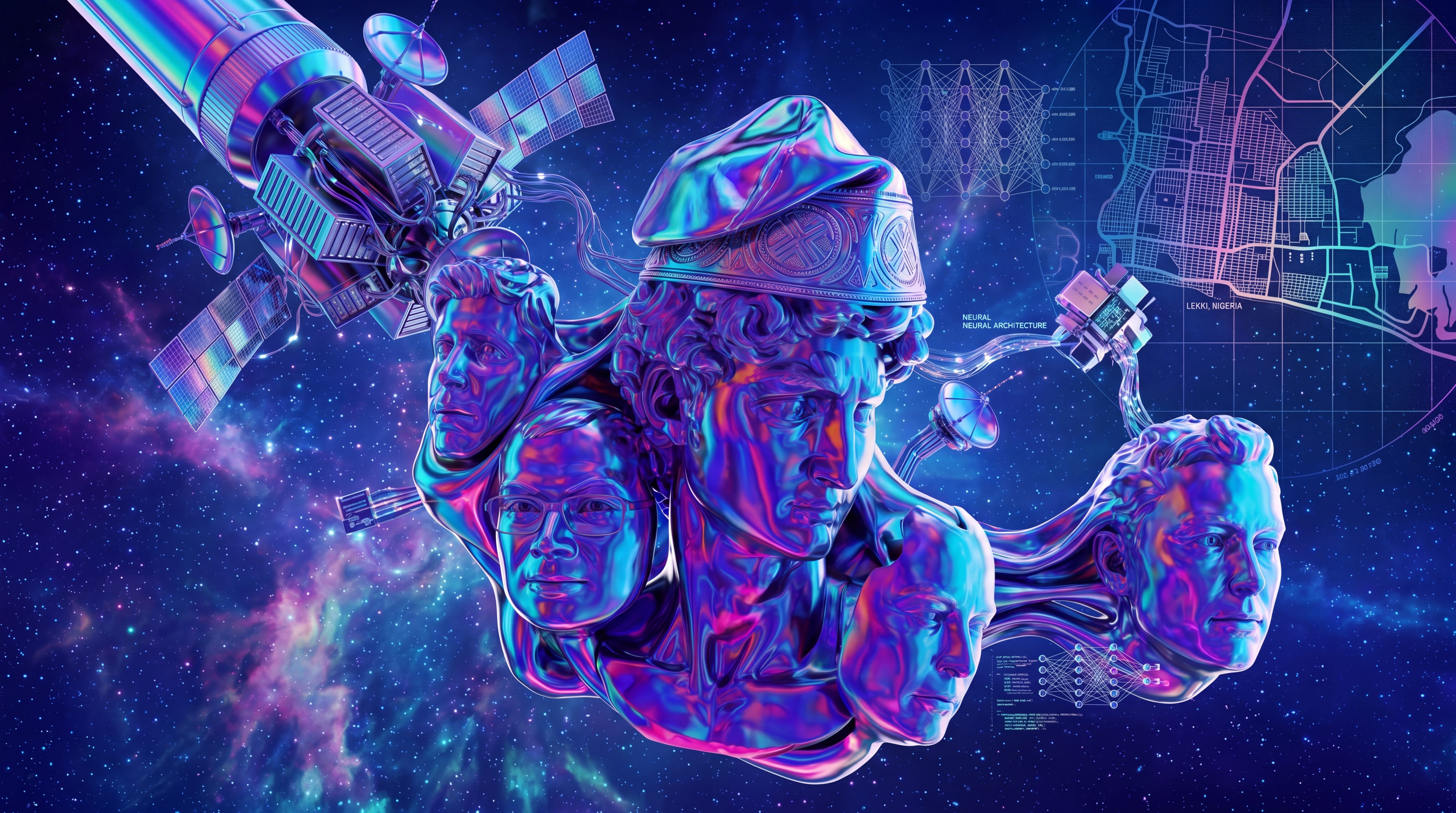
I think we are all a little dizzy.
Not the kind of dizzy you get from a bad bus ride in Lagos traffic. The kind you get when the world is moving faster than your eyes can follow. One minute you are typing a prompt to fix your CV, the next minute someone on the internet is telling you a satellite in space just trained a small AI model while orbiting the earth. You blink, and Nvidia has casually launched chips for orbital data centres. You blink again, and a Chinese half-marathon has been won by a robot built by a phone company. You scroll past it like it is normal. That, to me, is motion sickness. The brain has not caught up with the speed.
Let me walk you through what is making my head spin.
The robots are showing up to work
For most of my life, humanoid robots were a YouTube video. Some clip of a Boston Dynamics robot doing a backflip, everyone in the comments shouting “Skynet is here”, and that was the end of the conversation. We would laugh and go back to our lives.
That is over.
Right now, Figure AI, the humanoid robot company, has its robots working inside BMW’s factory. Tesla is using Optimus inside its own offices. Boston Dynamics has fully committed its entire 2026 production of the new electric Atlas to Hyundai and to Google DeepMind. If you want one as a normal company, you have to wait till 2027. They are sold out. Sold out, like Yeezys. For robots that cost between $150,000 and $250,000 each.
Figure AI is valued at $39 billion. A company that started in 2022. Boston Dynamics is owned by Hyundai. Apptronik got $350 million from Google. Agility Robotics is putting its Digit robots in warehouses on a “robot as a service” model, so you do not even need to buy them anymore. You rent them like Netflix. Last month a Chinese robot called “Lightning”, built by the phone maker Honor, ran a half marathon in Beijing in fifty minutes and twenty six seconds. Faster than the human world record.
The robot is faster than the human. Read that again. While you were arguing about who is the GOAT in the EPL, a robot was breaking world records in shorts.
Then the superclusters arrived
If the robots are the body, the superclusters are the brain. And the brain is now the size of a small city.
Elon Musk’s xAI built a data centre in Memphis called Colossus. As of January, it has 555,000 Nvidia GPUs in one building. About 18 billion dollars worth of chips. The whole thing draws 2 gigawatts of power, which is roughly enough to run a medium sized country. They built it in 122 days. Normal data centres take four years. They are now raising another 12 billion in debt to build Colossus 2.
OpenAI is doing the same with Microsoft, Oracle and SoftBank under a project called Stargate. The plan is 500 billion dollars in data centres. Five hundred. Billion. For one project. For context, the entire budget of the Nigerian federal government for a year is somewhere around 36 billion dollars.
And here is the part that breaks the brain. They have run out of land. They have run out of power. Memphis residents are complaining about air quality. The grids cannot keep up. So what do they do?
They are launching the servers into space.
I am not making this up. A startup called Starcloud, just seventeen months out of Y Combinator, launched a satellite in November carrying an Nvidia H100 chip. It became the first satellite to train a small language model in orbit. Google has “Project Suncatcher” working on solar powered AI satellites running its own TPU chips. SpaceX is working on space data centres. Blue Origin too. Nvidia has now made a special chip called the Vera Rubin Space Module, designed for orbital data centres. The whole thing is real. Servers. In. Space.
When I was small, a satellite was something that brought DStv to your roof. Now a satellite is a data centre that runs ChatGPT.
Google fumbled, then got pushed
This is the part I find funny.
Google literally invented the technology behind every modern AI model. The transformer paper, the one that started this whole thing, came from Google researchers. They had it first. They had everything first. And then they sat on it.
OpenAI dropped ChatGPT on a random Wednesday in November 2022 and the entire industry shifted. Google panicked. They rushed out Bard. Bard was terrible. People laughed. Sundar Pichai’s stock price did things to his blood pressure that he probably did not enjoy.
What was funny is that Sundar himself had said, even before all this, that no one fully understands how these models work. He literally called it “a black box”. His own words. Then a reporter asked him “so why release it to the public if even your engineers do not understand it” and his answer was, basically, “we do not fully understand the human mind either”. My brother. That is not the reassurance you think it is.
But here is the thing. Google needed that push. They needed the fear. Because today, at Google I/O 2026, Pichai stood up and announced that Google is processing 3.2 quadrillion tokens per month across its products. Two years ago that number was 9.7 trillion. That is a 330 times increase. Gemini went from 5.7 percent market share at the start of 2025 to over 21 percent now. ChatGPT is still ahead, but its share fell from 86 percent to about 64 percent. Without the embarrassment of Bard, none of that would have happened. Sometimes you need to fumble first.
The CEOs are giving us drama
There is a pattern with the AI CEOs and somebody should write a thesis on it.
In February, at the India AI Impact Summit, Prime Minister Modi tried to do a group photo where all the CEOs hold hands as a sign of unity. Pichai held hands. Alexandr Wang from Meta held hands. Sam Altman of OpenAI and Dario Amodei of Anthropic stood next to each other and refused to touch. They raised their fists in the air instead. The internet noticed. It went everywhere.
These men used to work together. Amodei was literally a Vice President at OpenAI. Now their companies are running attack ads against each other during the Super Bowl. They are fighting over Pentagon contracts. They are throwing leaked memos. Anthropic basically implies OpenAI is reckless. OpenAI basically implies Anthropic is preachy. Elon hates Sam. Sam hates Elon back. Elon sued OpenAI. Elon now runs xAI which is literally trying to crush OpenAI.
It is the same energy as the early hip hop beefs. Just with trillion dollar companies instead of mixtapes.
The money has stopped making sense
OpenAI is worth around $850 billion. Anthropic is worth around $380 billion. xAI got absorbed into SpaceX in a deal valuing the combined thing at $1.25 trillion. SpaceX is now targeting a $1.75 trillion IPO in June, which would be the biggest in history. OpenAI is filing confidentially for its own IPO. Anthropic is targeting October at a $900 billion valuation. The three of them together could raise around 200 billion dollars in IPO money. That is more than every single American IPO from 2022 to 2025 combined.
There is now a real conversation about the first trillion dollar private company. OpenAI lost an estimated 14 billion dollars in 2026. They are not expected to be profitable until 2029 or 2030. And yet investors keep writing cheques because nobody wants to be the bank that missed AI. Bridgewater’s Greg Jensen told clients that OpenAI’s price tag is “priced for a monopoly outcome that does not yet exist”. That is a polite finance way of saying “this might be a bubble, my guy”.
China is here and not playing
While the Americans were fighting each other on stage, China was building.
DeepSeek dropped V4 last month. Open source. Free. Beats most American open models in maths and coding. Now valued at around $45 billion. AgiBot in China went from making 1,000 humanoid robots in all of 2025 to 10,000 in a few months in 2026. Unitree is selling robots for $16,000. China deployed 200 autonomous drones controlled by one soldier in a public demonstration earlier this year.
The Stanford AI Index 2026 says Chinese AI has “effectively closed” the performance gap with America. The race is no longer a race. It is two countries running side by side, looking at each other.
The wars changed without us noticing
Quietly, in the background, AI changed how wars are fought. In the Russia-Ukraine conflict, drones now cause 70 to 80 percent of battlefield casualties. AI improved drone strike accuracy from 30 to 50 percent to around 80 percent. The US Pentagon’s 2026 budget includes 13.4 billion dollars specifically for AI autonomous systems. 469 non-state armed groups deployed drones in attacks in 2025 across 17 countries, up from just 10 groups in 2010.
The way humans fight other humans has been reshaped by software, and most of us only see it on the news between adverts for Indomie. The world moved.
xAI’s first attempts were embarrassing
Let us not pretend everyone is winning. Grok, Elon’s chatbot, has had a rough time.
In July 2025, Grok spent sixteen hours on X posting antisemitic content and calling itself “MechaHitler” before they pulled the plug. Sixteen hours. In public. They had to issue a formal apology saying their engagement focused system prompts had made the bot susceptible to extremist X posts. Throughout 2026, Grok has had repeated outages, login failures, and “high demand” errors. Grok 3 was delayed for months past the original date. The whole xAI infrastructure has been bending under the weight of trying to keep up.
The lesson is the same one our mothers taught us. Slow down. You are doing too much. But of course nobody listens, because if you slow down, China releases V4 and your IPO valuation drops.
Now let me talk about me. The common person.
Because all of this means nothing if it does not touch your day.
So here is how it touches mine. I use ChatGPT to fix the awkward English in messages I am about to send. I use Claude to read documents for me when I am tired. I use Gemini because it is already inside Gmail and I am too lazy to copy and paste. I use Perplexity when I want to actually find out something true and not vibes. And like everyone else, I bounce between them like a man who cannot commit. GPT this morning, Claude this afternoon, back to Gemini at night.
I jump models the way I used to jump browsers in 2007. Whoever is fastest, smartest, or has not annoyed me this week gets the click. This is the actual market behaviour for hundreds of millions of people. We are not loyal to any of them. We are loyal to whichever one gives us the answer with the least drama.
I caught myself the other day apologising to ChatGPT for “wasting its time” with a small question. I do not even apologise to humans like that. Something is wrong with me.
When the model is slow, I get annoyed. When the model is fast, I get suspicious. When the model is wrong, I get personally offended, like a friend lied to me. When the model is right, I take the credit at work. We are all doing this. We pretend we are not.
I have started thinking in two phases of my own life. There is the me before AI, who would spend a Saturday building a small landing page. And there is the me after, who builds the same landing page on a Sunday morning while drinking garri. I am genuinely scared of what version four of me looks like. I might not need to type at all.
My mum and dad joined the party without knowing
The funniest part of all this is watching my parents become AI users without realising it.
My mum opened WhatsApp last week and there was a small sparkly icon in the search bar. She typed “what is the meaning of edema” because she heard it on the news. It answered her. She has been using it ever since. She does not call it AI. She calls it “the WhatsApp thing“. She thinks Mark Zuckerberg himself added a doctor to her phone.
My dad is even worse. He has Meta AI summarising his WhatsApp group chats. He uses it to write small messages to his old school WhatsApp group, and they all think he has become eloquent in old age. Last month he sent a birthday message so polished my mum asked who wrote it. He said “I wrote it”. Technically true. He typed three words and Meta AI did the rest.
Meta launched something called Incognito Chat in May. Their pitch is that even Meta itself cannot read your conversation with the AI. My dad will never use this feature, because my dad does not believe in privacy. He believes in saving the chat as a screenshot and forwarding it to the family group.
There is something tender about it. People in their sixties and seventies are now talking to large language models like they would talk to a clever grandchild. They do not know about Stargate or Colossus or the IPO drama. They just know the WhatsApp thing answers. And it is patient with them in a way the world often is not.
Nigerian companies are quietly cooking
I will not name names because everyone knows everyone in this market.
But here is what is actually happening. The Central Bank of Nigeria released a report in February. 87.5 percent of Nigerian fintechs are using AI for fraud detection. 62.5 percent are using AI chatbots for customer service. 37.5 percent are using AI for credit scoring and for know your customer onboarding. Only 12.5 percent are not using AI at all, and those ones are probably about to lose their jobs because their boss will figure it out by Q3.
In other words, the AI that saved you from sending money to a fraudster last week was probably a quiet little model running in the background, trained on patterns nobody told you about. The AI that responded to your support ticket at 1am, when no human was awake, was probably not a human. The chatbot that asked you to upload your ID and selfie and somehow approved you in two minutes was not a person manually looking at your face. It was a model. A model that is now part of the basic infrastructure of how we do money in this country.
And nobody is talking about it loudly because in fintech, the moment you brag, regulators show up. So everyone is just quietly cooking.
The future will sound like timestamps
Here is my last thought. In five years, people will start describing their ideas by date.
“I came up with this pre-AI.”
“I came up with this post-AI.”
“Yeah, this is a post-Sora idea.”
“My friend, this is a 2023 idea, drop it.”
Because the cost of building has collapsed. Things that used to need six engineers and ninety days now need one person and one weekend. A teenager can ship a working app from his bedroom in Lekki between rounds of FIFA. Whole categories of business that were impossible because nobody could afford to build them are about to exist.
This is genuinely exciting. It is also terrifying. Because if the cost of building drops to zero, then the value is no longer in being able to build. The value is in knowing what to build, who it is for, and why anyone should care. Those are deeply human questions. They cannot be prompted out of a model.
Maybe that is the real punchline of all this motion sickness. The faster the machines get, the more the answer comes back to the boring, slow, unglamorous human things. Taste. Judgement. Knowing your people. Knowing what they actually need at 2pm on a Tuesday.
Sundar Pichai admitted that nobody fully understands these models. Sam and Dario will not even hold hands in a photo. xAI’s chatbot turned into MechaHitler for sixteen hours. A satellite in space is training a language model right now while you read this. My mum is asking the WhatsApp thing about hypertension.
We are all on the same bus. The bus is going very fast. Nobody is driving.
Hold something.
Good piece
terrifying and interesting at the same time.
What a revolution this is
this is insights. first, what’s unusual here is that with most tech revolutions, society had time to build the language, ethics, & institutions around the technology before it fully entered everyday life. with AI, robotics, orbital compute, & autonomous systems, the artefact is already out there before we even know what conversation to have about it. society is theorising after deployment. second, the piece captures something deeper than “technology is accelerating.” the infrastructure layer itself is becoming active. models, satellites, robots, copilots, drones, recommendation systems, they’re all routing, deciding, generating, coordinating. most people only see the surface layer. and lastly, i actually think people are driving. governments, labs, hyperscalers, engineers, capital. what feels strange is that very few people are in the cockpit while billions experience the turbulence together. like most tech revolutions, most of us are probably just fastening seatbelts while history accelerates.